
Unlocking Galactic Mysteries Relativistic Insight into Orbital Hyper-Speeds and Dark Matter in Gas-Rich Galactic-Halos
Abstract
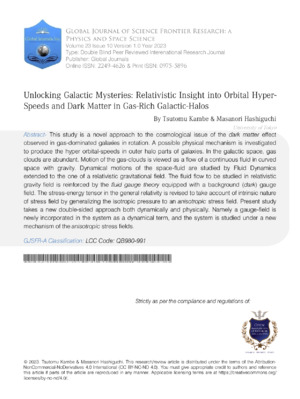
This study is a novel approach to the cosmological issue of the dark matter effect observed in Regarding the dark-matter effect, a strong evidence was found by McGaugh-Lelli-Schombert The dark matter effect is created by the action of the gauge field a. The gauge field is determined ported galaxies, on the basis of their observational stud- ies on hundreds of galaxies with different morphology, masses, sizes and gas fractions, They found a universal law, implying that the rotational motions of disk galax- ies are determined entirely (in a statistical sense) by the baryonic (hence visible) matters in the galaxies, even if the disks are filled with unknown dark matters. This hints strong connection between the observable baryonic matters and the physics producing the galactic orbital motions. Let us take a typical galaxy supported by rotation. From the orbital velocity V (R) observed at a distance R from the galactic center, its centripetal acceleration Ac (radial acceleration to the galactic center) is given by Ac = V 2/R. (1) On the other hand, the gravitational potential Φg is esti- mated by the Poisson equation for Φg: ∇2Φg = 4πG ρbar,
Downloads
How to Cite
References
S. McGaugh, F. Lelli, M. (MLS) (2016) 117, 201101.
Y. Sofue, V. (SR) (2001) 39, 137.
R. Tully, J. Fisher (1977) 54, 661.
T. Kambe (2021) Fluid gauge theory. 21, 113.
T. Kambe, waves mechanics (2020) New perspectives on mass conservation law & waves in fluid mechanics. 52, 1.
By analogy, this is like the ferrocement, a plaster reinforced with metal mesh, although it is a solid , not a fuid.
T. Kambe (2023) Relativistic exploration of dark matter effects in rotating galaxy, studied fluid-dynamically. 23(8), 13-27.
The second and third terms (v·∇) v+∇Φg of the last expression of (6) correspond to the Christoffel-symbol terms of the geodesic curved motion of the covariant derivative as an extension of the partial derivative ∂tv.
P ≡ ρh = (ρϵ+p) is the enthalpy per unit volume, where ϵ and h = ϵ + p/ρ are termed the internal energy and enthalpy per unit mass.
Y. Sofue (2018) 70, 31.
T. Kambe (2022) 22, 61.
G. Ludwig (2021) Galactic rotation curve and dark matter according to gravitomagnetism. 81, 186.
(∇× b) ϕ = ∂ZbR − ∂RbZ = −R−1∂2 ZΨ − ∂R(R−1∂RΨ).
With n = 2, the numerical analysis caused a complexity, while the correction terms vanish with the case of n = 4 on the plane Z = 0 and the numerical work succeeded in yielding the solution straightforwardly.
Pfenniger, F. Combes, A. L. Martinet, A (1994) [iv] S. 79.
McGaugh, F. Lelli, PRL M. Schombert (2016) [v] T. 117, 201101.
Kambe, T. Kambe, M.Hashiguchi (2023) [vi] T. 23(10), 1-13.
Published
2023-11-10
Issue
Section
License
Copyright (c) 2023 Authors and Global Journals Private Limited

This work is licensed under a Creative Commons Attribution 4.0 International License.