
Recurrent Relationships as an Important Class of Mathematical Objects in Chemistry
recurrent relations, chemistry, chromatographic retention, chemical variables, number of isomers, physicochemical properties, linear approximation
Abstract
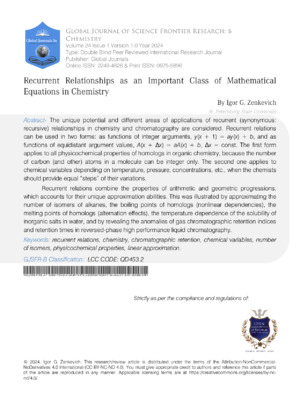
Recurrent relations combine the properties of arithmetic and geometric progressions, which accounts for their unique approximation abilities. This was illustrated by approximating the number of isomers of alkanes, the boiling points of homologs (nonlinear dependencies), the melting points of homologs (alternation effects), the temperature dependence of the solubility of inorganic salts in water, and by revealing the anomalies of gas chromatographic retention indices and retention times in reversed-phase high performance liquid chromatography.
Downloads
How to Cite
References
I Gutman, O Polanskii (1986) Mathematical Concepts in Organic Chemistry. 212.
M Cockett, G Doggett (2012) Maths for Chemists. 2 nd Edn. 417.
A Cunningham, R Whelan (2014) Math for Chemists. 119.
Christopher Oriakhi (2021) Chemistry in Quantitative Language. 528.
Igor Zenkevich (2009) Approximation of any physicochemical constants of homologues with the use of recurrect functions. 46(3), 913-933.
Igor Zenkevich (2009) Application of recurrent relationships in chromatography. 23(4), 179-187.
Igor Zenkevich (2010) Application of recurrent relations in chemistry. 24(3-4), 158-167.
I Zenkevich (2017) Recurrent Relationships in Separation Science. 24, 449-468.
Igor Zenkevich, Abdennour Derouiche, Darja Nikitina (2021) Detection of organic hydrates in reversed phase high performance liquid chromatography using recurrent approximation of their retention times. 44(11-12), 588-598.
Igor Zenkevich, Abdennour Derouiche (2024) Features and Advantages of the Recurrent Approximation of Retention Times in Reversed-Phase High-Performance Liquid Chromatography. 11(3), 69.
S Basin (1963) The Fibonacci Sequence As It Appears in Nature. 1(1), 53-56.
Parmanand Singh (1985) The so-called fibonacci numbers in ancient and medieval India. 12(3), 229-244.
T Brasch, J Bystrom, L Lystad (2012) Optimal control and the Fibonacci sequence. 154(3), 857-878.
D Lide, Ed (2003) CRC Handbook of Chemistry and Physics: A Ready-Reference of Chemical and Physical Data, 85th ed Edited by David R. Lide (National Institute of Standards and Technology). CRC Press LLC: Boca Raton, FL. 2004. 2712 pp. $139.99. ISBN 0-8493-0485-7.. 127(12), 4542-4542.
Henry Henze, Charles Blair (1931) THE NUMBER OF ISOMERIC HYDROCARBONS OF THE METHANE SERIES. 53(8), 3077-3085.
H Henze, C Blair (1931) The number of structurally isomeric alcohols of the methanol series. 53, 3042-3046.
Douglass Perry (1932) THE NUMBER OF STRUCTURAL ISOMERS OF CERTAIN HOMOLOGS OF METHANE AND METHANOL. 54(7), 2918-2920.
J Song, R Thompson, T Vorburger, S Ballou, J Yen, T Renegar, A Zheng, R Silver, M Ols (2017) Establishing a Traceability and Quality System for U.S. Ballistics Identification Using NIST SRM Standard Bullets and Cartridge Cases. 12(3), 53-55.
E Soczewinski (1980) Quantitative retention-eluent composition relationships in liquid chromatography. 12, 1781-1806.
L Snyder, J Kirkland, J Dolan (2009) Introduction to modern liquid chromatography.
B Saifutdinov, V Davankov, M Il'in (2014) Thermodynamics of the sorption of 1,3,4-oxadiazole and 1,2,4,5-tetrazine derivatives from solutions on hypercrosslinked polystyrene. 88(3), 358-364.
B Saifutdinov, A Buryak (2019) The Influence of Water-Acetonitrile Solvent Composition on Thermodynamic Characteristics of Adsorption of Aromatic Heterocycles on Octadecyl-Bonded Silica Gels. 81(6), 754-761.
Bodil Jerslev, Sine Larsen, Emil Ratajczak, Alfred Sillesen, Julio Pellicer (1991) Hydrogen Bonding and Stereochemistry of Ring-Hydroxylated Aromatic Aldehyde Oximes. Crystal Structures of Three 4-OH-Substituted Benzaldehyde Oximes.. 45, 285-291.
Bodil Jerslev, Sine Larsen, Antonio De La Hoz, Johan Springborg, Markku Sundberg, M Kady, S Christensen (1992) Crystallizations and Crystal Structure at 122 K of Anhydrous (E)-4-Hydroxybenzaldehyde Oxime.. 46, 1195-1199.
M.-L Guo (2004) 4-Acetamido-N-(4-methylpiperazinyl)benzenesulfonamide monohydrate. 60(4), o574-o575.
P Suchetan, Sabine Foro, B Gowda, M Prakash (2012) 4-Chloro-N-(3-methylbenzoyl)benzenesulfonamide monohydrate. 68(1), o46-o46.
A Kompella, S Kasa, V Balina, S Kusumba, B Adibhatla, P Muddasani (2024) Large scale Recurrent Relationships as an Important Class of Mathematical Equations in Chemistry Global Journal of Science Frontier Research ( B ).
Published
2024-09-06
Issue
Section
License
Copyright (c) 2024 Authors and Global Journals Private Limited

This work is licensed under a Creative Commons Attribution 4.0 International License.